
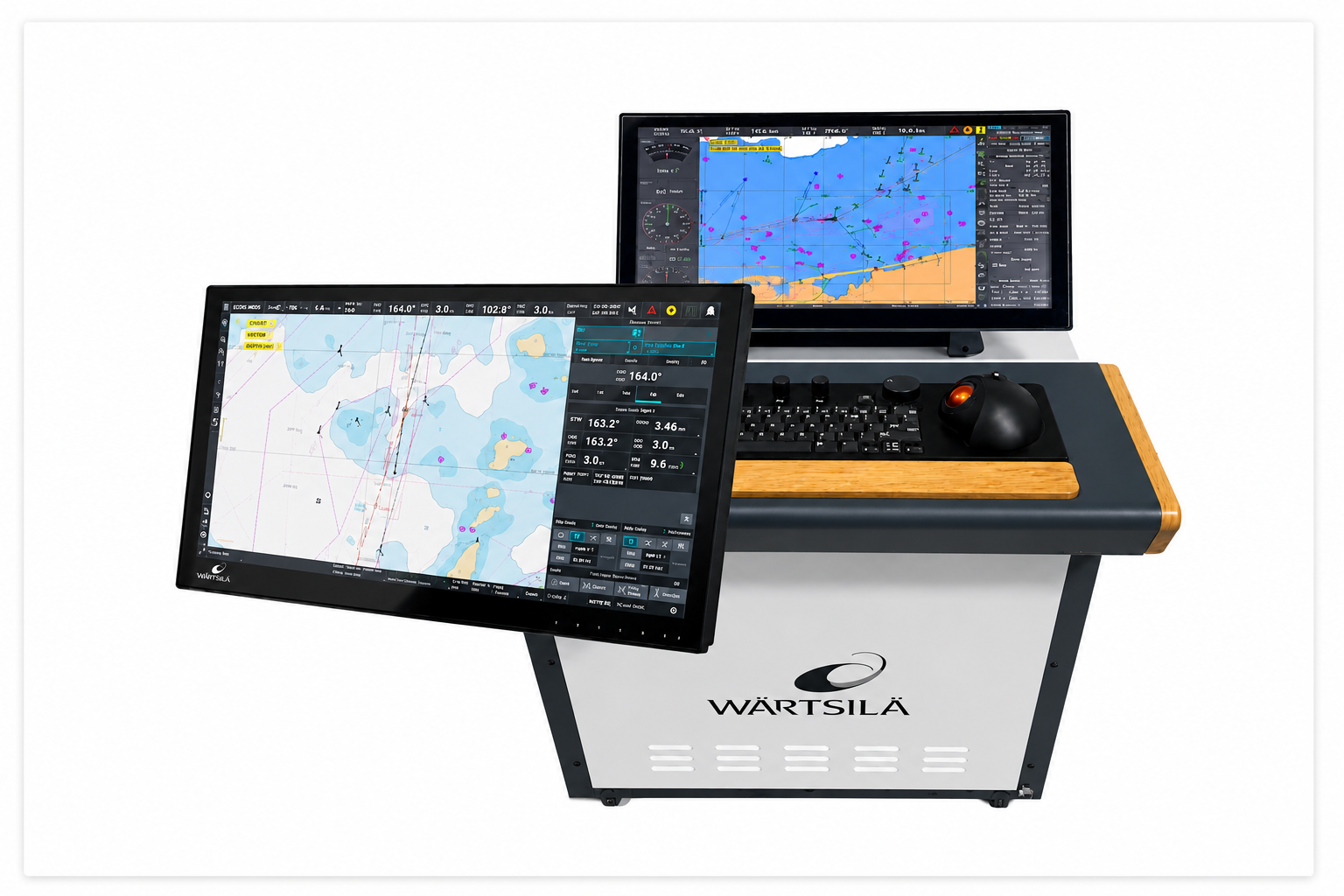
Wärtsilä ECDIS
Future-ready electronic navigation for modern vessel operations and the transition toward S-100 based navigation.
Wärtsilä Navi-Sailor ECDIS combines electronic navigational charts with vessel positioning, voyage planning and navigation sensor information to support safer and more efficient bridge operations.
With flexible configurations, bridge integration, voyage planning capabilities, service support and a pathway toward evolving S-100 navigation requirements, Navi-Sailor is designed to support today's operations while helping fleets prepare for tomorrow.
The maritime navigation industry is transitioning toward the IHO S-100 framework. Navi-Sailor provides a platform designed to support today's electronic navigation requirements while preparing fleets for the evolving digital navigation environment.
The exact capabilities and upgrade path depend on the installed configuration, software version and applicable regulatory requirements. Shipowners and fleet managers should assess these factors when planning new installations, retrofits or navigation system upgrades.
Designed to support the industry's transition toward S-100 based navigation data.
Designed for integration across navigation equipment, bridge systems and vessel configurations.
Service and support are available through the Wärtsilä maritime service and partner ecosystem.
Training and familiarisation can be supported through simulator-based navigation training and Wärtsilä training resources.
An Electronic Chart Display and Information System (ECDIS) is a computer-based navigation information system designed to support voyage planning, route monitoring and electronic chart navigation. It combines Electronic Navigational Charts (ENCs) with information from positioning equipment and other navigation sensors to provide bridge teams with an integrated view of the vessel's navigational environment.
The International Maritime Organization adopted performance standards for electronic charts and subsequently amended SOLAS regulation V/19 to allow compliant ECDIS to meet applicable chart-carriage requirements. Mandatory ECDIS carriage was phased in from 2011 for applicable ships.
When ECDIS is used to meet SOLAS chart-carriage requirements, the equipment must meet the applicable type-approval and standards requirements, use appropriate up-to-date ENCs and have an adequate independent backup arrangement.
Navi-Sailor 4000 brings electronic chart information, vessel positioning, navigation sensor data and voyage-planning functions into an integrated navigation environment. The platform is intended to support route preparation, voyage execution and bridge situational awareness.
Electronic navigational chart information is presented together with vessel position and relevant navigation data.
The platform supports route preparation and can be complemented by Navi-Planner for broader voyage planning workflows.
Position, heading, speed and other navigation inputs can be combined with chart information according to vessel configuration.
Bridge teams can monitor vessel movement, route progress and navigation status during voyage execution.
The platform is designed for integration within an electronic bridge environment and can work with connected navigation equipment.
The platform supports fleet planning considerations as the maritime industry transitions toward S-100 based navigation.
Navi-Sailor configurations can be selected according to vessel requirements, bridge architecture and the level of functionality required by the operator.
An entry-level configuration focused on core electronic chart navigation and the essential functionality required for ECDIS operations.
An enhanced configuration that builds on core ECDIS functionality with additional capabilities for operators requiring greater flexibility.
A more integrated configuration designed for operators seeking additional functionality, display capabilities and navigation features.
An advanced configuration intended for vessels requiring a broader range of integrated navigation functionality and enhanced operational flexibility.
The Navi-Sailor 4000 Multi-Function Display (MFD) provides a flexible workstation architecture for vessels that require multiple navigation applications within an integrated bridge environment.
Depending on the selected configuration, a workstation can support applications such as ECDIS, radar, conning and voyage-planning functions. This allows operators to use workstation resources efficiently while maintaining access to the applications required for vessel operations.
ECDIS navigation
Radar functionality
Conning information
Voyage planning
Chart management
Weather information
Integrated bridge workstation architecture
Flexible application configuration
Navi-Planner can complement Navi-Sailor ECDIS by providing a connected approach to voyage planning and execution. Route creation, safety checks, chart management and voyage optimisation can be brought together before the vessel sails.
Berth-to-berth passage planning
Route creation and editing
Route checking and safety assessment
Electronic navigational chart management
Weather and environmental information
MARPOL, ECA/SECA and piracy-related overlays
Voyage optimisation
Navi-Planner and Navi-Sailor synchronisation
Navi-Sailor combines electronic chart navigation with voyage planning, route checking, monitoring and integration with bridge navigation information. This integrated environment is designed to support situational awareness and efficient bridge operations.
Navi-Sailor integrates navigation inputs from GPS/GNSS and other bridge sensors to provide positional and navigational information on electronic charts.
As GNSS interference becomes an increasing navigation concern, maintaining awareness of positioning information is essential. Navi-Sailor brings navigation sensor information together with chart and voyage data to support informed bridge decisions.
Navi-Sailor supports voyage planning and can be complemented by Navi-Planner for advanced passage planning, route preparation and chart management.
Route planning and checking help bridge teams identify potential navigational hazards before voyage execution and support safer route preparation.
During voyage execution, Navi-Sailor provides monitoring of vessel position, track and navigation status to help bridge teams maintain awareness of voyage progress.
Depending on vessel configuration, Navi-Sailor can work with bridge sensors, radar systems and navigation equipment to bring relevant information together.
Modern bridge operations depend on information from multiple navigation systems. ECDIS provides the electronic chart environment in which this information can be interpreted alongside vessel position, route and navigational data.
Depending on the vessel's bridge configuration, Navi-Sailor can work with navigation inputs such as GNSS/GPS, heading, speed, radar and AIS. Bringing relevant information together can help bridge teams maintain a more complete understanding of vessel movement, surrounding traffic and route progress.
This integrated approach is particularly relevant as bridge teams increasingly manage navigation risks associated with complex traffic environments, changing weather conditions and GNSS interference.
ECDIS operates within an international regulatory and technical framework involving the International Maritime Organization (IMO), International Hydrographic Organization (IHO) and International Electrotechnical Commission (IEC).
IMO SOLAS requirements establish the carriage framework for shipborne navigation equipment and allow compliant ECDIS to satisfy applicable chart-carriage requirements.
IMO Electronic Charts & ECDIS →IHO standards define important requirements for electronic navigational charts, ECDIS presentation and the emerging S-100 data ecosystem.
IHO ENC & ECDIS Standards →IEC standards establish technical and performance requirements relevant to shipborne ECDIS equipment and testing.
IEC Standards →Electronic Navigational Charts (ENCs) are a fundamental part of ECDIS operations. Where ECDIS is being used to meet SOLAS chart-carriage requirements, IHO states that it must use up-to-date ENCs and remain compatible with the latest applicable IHO standards.
An adequate independent backup arrangement is also required when ECDIS is used for the relevant SOLAS carriage requirements. The appropriate backup arrangement should therefore be considered during equipment selection and vessel installation.
Wärtsilä provides nautical digital services for charts, publications and related maritime data services within its navigation ecosystem.
The maritime navigation industry is moving toward the IHO S-100 framework, which provides a modern model for a broader range of hydrographic and marine information products.
S-101 is the next-generation specification for Electronic Navigational Charts. Other S-100 product specifications address information such as bathymetry, water levels, surface currents, navigational warnings and under-keel clearance.
S-101
Electronic Navigational Chart
S-102
Bathymetric Surface
S-104
Water Level Information
S-111
Surface Currents
S-124
Navigational Warnings
S-128
Catalogue of Nautical Products
S-129
Under Keel Clearance Management
The transition toward S-100 is an important development for electronic navigation. Shipowners and fleet managers should evaluate current system capabilities, software versions, chart services, equipment compatibility and future regulatory requirements when planning navigation system upgrades.
Navigation technology is most effective when supported by appropriate crew familiarisation, technical support and lifecycle planning. Wärtsilä provides training and service resources through its maritime ecosystem.
Effective ECDIS operation depends on both appropriate equipment and properly trained bridge personnel. Familiarisation should cover chart management, route planning, alarms, navigation functions and system limitations.
Wärtsilä provides navigation simulator and training solutions designed to support ECDIS familiarisation and navigation training.
Explore Wärtsilä ECDIS Simulator →ECDIS is a lifecycle-critical navigation system. Software maintenance, chart services, technical support and appropriate upgrades are important considerations for shipowners and fleet managers.
Long-term navigation technology planning should consider equipment configuration, software, chart services, crew requirements and evolving regulatory standards.
Explore Wärtsilä data and service resources →Marine Innovation supports maritime customers seeking navigation technology and marine equipment solutions for vessel and fleet requirements. Our focus is on helping customers understand available technology, evaluate system requirements and make informed decisions around navigation equipment.
For shipowners, ship managers and maritime operators evaluating an ECDIS installation, retrofit or navigation system upgrade, the appropriate solution depends on vessel type, bridge architecture, operational requirements, chart services, integration requirements and future regulatory considerations.
Contact Marine Innovation to discuss Wärtsilä Navi-Sailor 4000 ECDIS requirements, vessel applications and navigation technology options.
Wärtsilä Navi-Sailor 4000 ECDIS, formerly known as Transas Navi-Sailor ECDIS, is an electronic chart navigation system designed to support voyage planning, route monitoring and navigation using electronic navigational charts and information from connected navigation sensors.
Wärtsilä positions Navi-Sailor ECDIS for the industry's transition toward S-100 based navigation. Specific capabilities and upgrade paths depend on the installed configuration, software version and applicable requirements.
S-101 is the IHO product specification for next-generation Electronic Navigational Charts within the S-100 framework.
A type-approved ECDIS using up-to-date official ENCs can satisfy applicable SOLAS chart-carriage requirements when operated according to relevant regulations and standards and when an appropriate independent backup arrangement is provided.
Depending on the vessel configuration, ECDIS can receive information from systems such as GNSS/GPS, heading and speed sensors, radar, AIS and other navigation equipment.
Navi-Planner is a voyage planning application within the Wärtsilä navigation ecosystem that supports route creation, route checking, chart management, weather information and voyage planning workflows.
Wärtsilä Navi-Sailor ECDIS is supported through Wärtsilä's maritime service and partner ecosystem. Marine Innovation can assist customers in evaluating navigation technology requirements and discussing suitable ECDIS solutions.
Discover a comprehensive electronic navigation solution designed around voyage planning, electronic charts, bridge integration, navigation monitoring and the industry's transition toward S-100 based digital navigation.
Enquire About Wärtsilä ECDISShare this Wärtsilä ECDIS page